ENFOUR TYPE COLLECTION TypeBank 01
ENFOUR TYPE COLLECTION TypeBank 01 (Feb 1999) packaged 16 TypeBank Mincho, Gothic, and Maru Gothic typefaces as PDF-embeddable CID fonts.

TypeBank / ENFOUR TYPE COLLECTION
TypeBank 02 (May 1999) added seven new typefaces, including Midashi Mincho, Classic Mincho, TV Mincho, and Gothic SL, as embeddable CID fonts.

ENFOUR TYPE COLLECTION TypeBank 02, released in May 1999, added seven new TypeBank typefaces shaped by feedback from DTP users: TypeBank Mincho L, Classic Mincho H, Midashi Mincho, TV Mincho, Gothic SL, Gothic U, and Calligra Gothic E. Like TypeBank 01 it uses sfntCID ATM fonts with full glyph-switching and kerning support and can be embedded in PDF. TypeBank 04 is its single-typeface edition.
| Released | May 1999 |
|---|---|
| Typefaces | TypeBank Mincho L; TypeBank Midashi Mincho; TypeBank Classic Mincho H; TypeBank TV (Terebi) Mincho; TypeBank Gothic SL; TypeBank Gothic U; TypeBank Calligra Gothic E |
| Formats | ATM sfntCID; PS OCF or CID |
| Status | Enfour sales ended March 2003 |

The TypeBank Professional Font Series and ENFOUR TYPE COLLECTION TypeBank 01–04: Japanese CID fonts that pioneered PDF embedding.
Editorial note: the following romanisations are best readings from the Japanese originals and are awaiting confirmation: Midashi Mincho, TV (Terebi) Mincho and Calligra (Caligra) Gothic Latin spellings.
Historical product information from Enfour’s original Japanese font site, translated into English. Prices, addresses, and ordering details from the period are omitted.
A headline face created to give pages strong impact and rich expression. Generous verticals and fine, delicate horizontals give high contrast, combining softness with sharpness. Elements carry the roundness, curves, and tension of analogue type for a friendly design. A step bolder than Classic Mincho H, with wide, voluminous counters that emphasise the line of set text. The kana keep the movement of the brush, with stroke contrast like the kanji, for a dignified, elegant look.

Made so horizontal strokes do not vanish or flicker on TV captions and game screens with limited scan lines. Horizontals are heavier, and the overall weight was set with production professionals. Elements are large and sharp, and sweeping strokes keep a constant thickness to their tips. Ideal for professional TV captions and film/game subtitles, and equally effective for home video editing, posters, and reversed-out text over photos or patterns.

Caligra Gothic is a gothic with calligraphic (handwritten) elements: a kaisho (regular script) skeleton with sharp gothic elements, conveying refined gentleness. Effective where kaisho feels too stiff and traditional, but Mincho or ordinary gothic feels too plain. Japanese characters have no fixed shape — tall, wide, diamond, peaked — and vary in size, stroke count, and line; the quality of a typeface depends on how well they are balanced. Caligra Gothic respects the free skeleton of kaisho while ensuring readability and a beautifully aligned line of text.
ATM: Macintosh or Power Macintosh running KanjiTalk 7.1.2 or later (including Mac OS 8.5); about 3 MB free disk space; 2HD (1.44 MB) floppy drive (USB FDD OK); CD-ROM drive; Adobe Type Manager 3.9.1J or later.


ENFOUR TYPE COLLECTION TypeBank 01 (Feb 1999) packaged 16 TypeBank Mincho, Gothic, and Maru Gothic typefaces as PDF-embeddable CID fonts.
TypeBank 03 and 04 offered TypeBank 01 and 02 typefaces individually, so designers could license just the faces they needed.

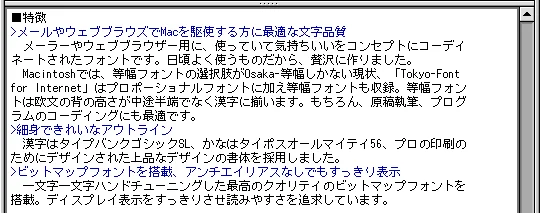
Tokyo-Font for Internet (2002) paired TypeBank Gothic SL kanji with Typos 56 kana and hand-tuned bitmaps for crisp Mac email and web text.
ENFOUR TYPE COLLECTION TypeBank 01 (Feb 1999) packaged 16 TypeBank Mincho, Gothic, and Maru Gothic typefaces as PDF-embeddable CID fonts.
TypeBank 03 and 04 offered TypeBank 01 and 02 typefaces individually, so designers could license just the faces they needed.
The TypeBank Professional Font Series (1995–1996) was the world's first CID font package: TypeBank and Ajioka kana fonts in Naked CID and OCF.
TypeBank's five-part essay on Japanese type design: what a typeface is, design elements, digital fonts, the family concept, and TypeBank faces.