
Mobile · 1993–2009
At the start of mobile computing
Before the iPhone, Enfour built software and services for PDAs and the first generation of smartphones: input methods and dictionaries for handhelds, Java apps and tools for i-mode, official content on every Japanese carrier and abroad, emoji for hardware makers, and multilingual and multimedia solutions for carriers around the world.
Overview
Handhelds that could read and write Asian languages
Enfour’s mobile work began with the Apple Newton in 1993. Our speciality was the hard part of handhelds in Asia: getting them to display, input and look up Japanese, Chinese and Korean. That technology, the UniFEP input method and our fonts and dictionaries, moved with us from one platform to the next.
When phones went online, we followed: official content on i-mode, J-Sky and EZweb, Java tools for i-mode developers, fonts and emoji for the companies making the devices, and services for carriers in Japan, Australia, the UK and Singapore. This page shows the products. The full story, year by year, is on our history page.

PDAs and handhelds
Software for every major handheld platform
The first third-party Newton software (1993), UniFEP Japanese input (1994), fonts, handwriting recognition, the Newton Language Kit, cables and an infrared pod, and The Newton Shop in Ginza.
Psion and EPOC
Enfour became the face of Psion in Japan in 1999, with the Japanese 5mx PRO, Chinese revo, UniFEP for EPOC and UniFEP V2 (2000), and UniFEP Light Korean and Japanese for Symbian OS (2001–2002).
Nokia Communicator and S60
UniFEP for Communicator brought Japanese to the Nokia 9210, sold by Nokia itself from 2003. UniDict for S60 followed in 2007 as an embedded dictionary for S60 3rd Edition phones.
Palm and Sony CLIÉ
Sony chose Enfour fonts for the CLIÉ (2001). Enfour also published Japanese Palm titles, from SimCity for Palm to PocketMoney and security software.
Pocket PC and Windows CE
Chinese UniFEP for Pocket PC (2002), plus Japanese games and utilities for Windows CE.
Embedded and car navigation
The Honda Internavi PDA project (2000), Asian-language sync for Symbian devices with 2K Development (2001), and multilingual input for Tao Group’s intent platform (2002).
i-mode and the first smartphones
Official content on every Japanese carrier
In 2003 Enfour became the only company offering multilingual services on the official menus of all three Japanese networks: NTT DoCoMo’s i-mode, J-Phone’s J-Sky (later Vodafone and SoftBank) and KDDI’s au EZweb.
TangoTown
Japanese language and lifestyle for non-native speakers: dictionaries, the first mobile SKIP kanji lookup, phrasebooks and daily lessons. J-Sky and i-mode (2002), EZweb (2003).
American Heritage and 総合英語辞典
The American Heritage dictionaries on Japanese phones for the first time (2003–2004), with 70,000 recorded pronunciations to download and play on the handset.
GlobalNavi
Roaming content for Vodafone’s 3G network (2003): dictionaries, phrasebooks, translation, maps and travel guides in the traveller’s own language, with Java guide-book apps.
Multilingual Translator
Translation between 12 European and Asian languages, drawing scripts the handset couldn’t display as images, with audio. On i-mode, Yahoo!Keitai and EZweb (2008), and abroad.
マイル名人 (Mile Meijin)
Air-mile strategy content with Media Sangyo Kenkyujo: i-mode (2009), then SoftBank and au (2010).
Special services
For the Athens Olympics (2004), TangoTown translated between ten languages on roaming phones in Greece and at home.
Java apps and tools
For the people building the mobile web
Java (i-appli) apps
Our services shipped with downloadable Java apps, such as GlobalNavi’s guide books, alongside the browser content.
i-JADE
With Zentek, Enfour brought i-JADE, the de facto standard emulator for creating i-mode Java apps, to English-speaking developers (2003), on Windows and Mac.
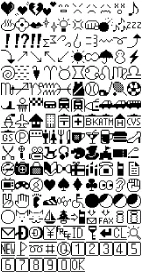
A TrueType font with i-mode’s 206 emoji and gaiji, plus a free proxy server, so i-mode sites displayed correctly in desktop browsers for the first time (2001).
GlobalVu
A transcoding proxy server that reshaped web content for small screens and handsets.
For hardware makers and carriers
Emoji, multimedia and languages, built in
Behind the services, Enfour supplied technology to the companies making and running the devices. Clients in 2003 included NTT DoCoMo, Vodafone, KDDI, Nokia Japan, Sony, Sun Microsystems, Zentek, SavaJe Technologies and Psion Teklogix.
Emoji for hardware makers
Enfour shipped emoji solutions to hardware manufacturers. Our emoji, redrawn from the original handset bitmaps as scalable outlines, let phone pictographs appear correctly on devices, desktops and in printed manuals.
Multimedia for carriers
Enfour delivered multimedia and multilingual solutions for carriers worldwide, including multilingual text for Tao Group’s intent multimedia platform (2002), used in smart mobile devices and digital TVs.
Mobile content abroad
Oxford Dictionary, TangoTown and Multilingual Translator on Telstra’s i-mode in Australia (2005), then Oxford, Multilingual Translator and a Chinese dictionary on O2 in the UK and StarHub in Singapore (2005).
Based on Enfour’s original press releases and product pages on www.enfour.com and www.enfour.co.jp. Product and company names are trademarks of their respective owners.
Then came the iPhone
From i-mode to the App Store
In 2008 we brought everything we had learned to the iPhone, and our dictionary and language apps still run on iPhone, iPad and Mac today.
Next steps
Three ways to start with Enfour
Free
Intro call
A short, free call to introduce what you need and see whether we are the right fit. Tell us a good time and we will call you.
¥32,200 + tax
Decision Session
A paid 45-minute call to talk through your systems and agree what to do first.
Apps
Buy our apps
Dictionary, language, and reference apps on the App Store, plus FrontierStack for server management on macOS.