

Music Gaiji
Enfour Music Gaiji: Pictographs Before Emoji
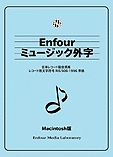
Enfour Music Gaiji (1996) brought RIS 506-1996, the Japanese record industry character set with music symbols and pictographs, to the Mac years before mobile emoji.
At a glance
Enfour Music Gaiji (1996) was a Macintosh gaiji font package for RIS 506-1996, the character code standard of the Recording Industry Association of Japan. Alongside music symbols, the standard gave pictographs for weather, food, hearts, faces, animals and vehicles their own character codes, a few years before emoji reached Japanese mobile phones. The outline designs used in the standard’s appendix are Enfour’s.
Key facts
| Released | 1996 |
|---|---|
| Standard | RIS 506-1996, Character Codes for Records (Recording Industry Association of Japan) |
| Character codes | Shift JIS user-defined area, F070 to F09C |
| Platform | Macintosh, KanjiTalk 7.1 or later, with Adobe Type Manager 3.5J and Adobe Type Composer |
| Status | Historical product |
What came next
Five years later, Enfour’s Keitai-Font showed NTT DoCoMo i-mode emoji on Windows and Mac computers.
Based on Enfour’s original 1996 Japanese product page, translated into English. Prices and ordering details from the period are omitted. Background on the standard: レコード用文字符号 (Japanese Wikipedia).
Details
Music symbols, pictographs, and the road to emoji
A character set for the record industry
In 1996 the Recording Industry Association of Japan published RIS 506-1996, Character Codes for Records (レコード用文字符号), a common set of character codes for the record industry.
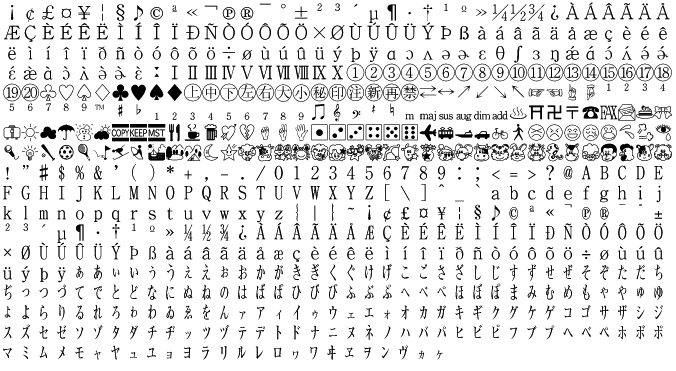
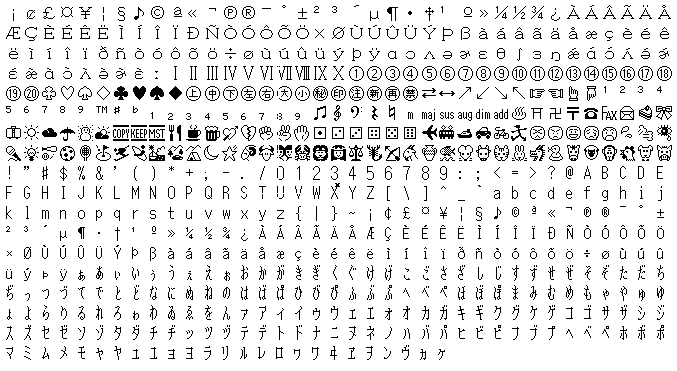
Besides accented Latin letters, Roman numerals, circled numbers and music notation, RIS 506 included a large set of small pictures: sun, clouds, umbrella and snowman; telephone and fax; cups, beer and food; hearts, including a broken heart; faces with different expressions; animals; dice; planes, trains, boats, cars and bicycles; hand signs; and enclosed kanji such as 新 (new) and 秘 (secret). Each one was a character with its own code, not an image.
Enfour Music Gaiji
Enfour Music Gaiji brought this character set to the Macintosh. It placed the RIS 506 characters in the user-defined area of Shift JIS, at codes F070 to F09C, and came with a ready-made composite font for Hoso Mincho, an input method dictionary, and a manual with a code table. With Adobe Type Composer, users could add the characters to their own Japanese ATM fonts, so the symbols could be typed and printed alongside ordinary Japanese text.
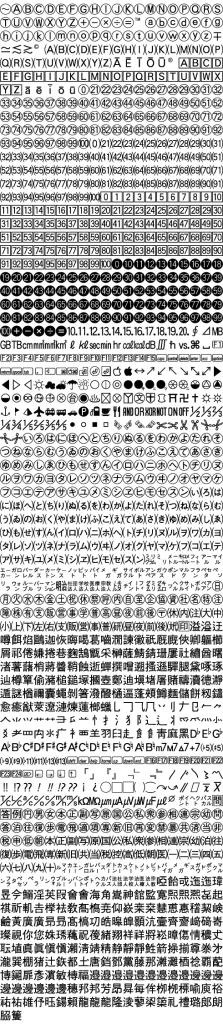
The standard has two sets of glyph designs. Sony owns the 16 × 16 dot bitmap designs, and Enfour owns the outline font designs used in the standard’s appendix. Both character charts are shown below.
A forerunner of emoji
Emoji are usually traced to Japanese mobile phones at the end of the 1990s: J-Phone put pictographs on its handsets in 1997, and NTT DoCoMo’s i-mode followed in 1999. RIS 506 had already given weather symbols, faces, hearts, food and vehicles their own character codes in 1996. It is the same idea that makes emoji work: a picture treated as a character, so it can be typed, stored and sent as text. When Google and Apple proposed adding emoji to Unicode in 2009, their proposal (WG2 N3582) cited RIS 506.
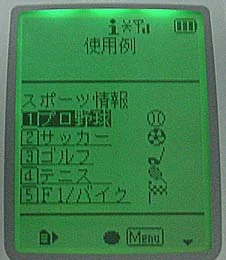
Enfour’s own work carried on in the same direction. In 2001 Keitai-Font displayed i-mode emoji on Windows and Mac computers, so web designers could build and check i-mode sites on the desktop.
Gallery
Original character charts
Related typography
Explore related products
Tokyo-Font & Keitai-Font
Keitai-Font (2001) displayed NTT DoCoMo i-mode emoji on Windows and Mac, so designers could build i-mode sites on a computer.
Enfour Gaiji DX
Enfour Gaiji DX (1998) added about 1,500 gaiji to Mac OS and Morisawa DTP fonts, in i, TrueType, ATM and PS editions.
Tokyo-Font & Keitai-Font
Enfour’s TrueType screen fonts: Tokyo-Font for Internet for Mac email and web, and Keitai-Font, which showed i-mode emoji on computers.