Skip to content

Comic-Font & CELSYS

Comic-Font and the CELSYS Partnership

Comic-Font (2001) put manga speech-balloon lettering into TrueType for Mac and Windows, and Enfour partnered with CELSYS on comic fonts.
At a glance

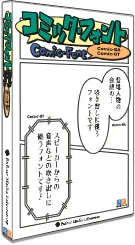
Comic-Font is Enfour’s digital font pack for the lettering in manga speech balloons, released in mid-July 2001 as a Windows and Macintosh hybrid. Comic-GA sets characters’ dialogue and Comic-GT sets voices through a loudspeaker, recreating the classic phototypesetting mix of Gothic kanji with Mincho kana. Enfour Media Laboratory also partnered with CELSYS, maker of the ComicStudio manga software, to develop next-generation fonts for digital comic production.

Key facts

ReleasedMid-July 2001
TypefacesComic-GA (dialogue), Comic-GT (loudspeaker)
FormatJapanese TrueType, Windows/Mac hybrid; PDF-embeddable
DesignTypeBank Co., Ltd., Shintaro Ajioka, Group Typo
PartnerCELSYS, Inc. (ComicStudio)
Comic-Font and the CELSYS Partnership: cfgt (original Enfour artwork)
Part of

Every Enfour product line in one place: gaiji fonts, edit kits, TypeBank, kana, Comic-Font, screen fonts, FONT1000, and the support archive.

Historical product information from Enfour’s original Japanese font site, translated into English. Prices, addresses, and ordering details from the period are omitted.

Details

Background

Comic-Font

Comic-Font and the CELSYS Partnership: CFlogo 2 (original Enfour artwork)

The lettering of manga speech balloons, as digital fonts!
Comic-Font and the CELSYS Partnership: cfgt (original Enfour artwork) Comic-Font and the CELSYS Partnership: cfga (original Enfour artwork) Comic-Font and the CELSYS Partnership: cfp (original Enfour artwork)
  • The ideal font pack for creating manga on Mac OS or Windows.
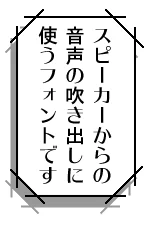
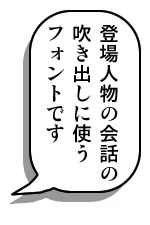
  • “Comic-GA” for balloons where characters are talking, and “Comic-GT” for balloons of sound through a loudspeaker.
  • Japanese TrueType fonts supporting each OS’s standard character set.
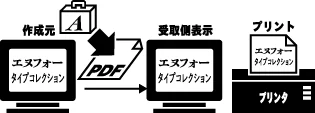
  • Supports embedding in PDF files.

Typefaces

  • Comic-GA — for characters’ dialogue balloons
  • Comic-GT — for loudspeaker-sound balloons

Specifications

  • Windows: Japanese TrueType; Microsoft standard character set
  • Macintosh: Japanese TrueType; KanjiTalk 7 character set

Requirements

  • Windows: PC/AT-compatible running Windows 98/98 SE/Me/NT 4.0/2000/XP; CD-ROM drive; about 5 MB free disk space (2 typefaces)
  • Macintosh: a Macintosh that can run KanjiTalk 7.6.1 to Mac OS 9.2.2; CD-ROM drive; about 5 MB free disk space (2 typefaces)

Typeface copyright & design

Q&A

Q: Will there be a PostScript version? – Typos Allmighty 211 in our [Typos Allmighty]

Because the font formats differ, the symbol sets (platform-specific characters such as circled numerals) of the combinations above differ from those of Comic-Font.

License Q&A

I want to distribute my work on the internet. Please distribute it as a PDF with the fonts embedded, or as image files. Files with the text converted to outlines are not permitted for distribution, because third parties could reuse the outline data.

I want a print shop to print my work. Only for printing your work, you may give data with the fonts converted to outlines to the person in charge at the print shop. The print shop may not modify the outlined characters or reuse them for other purposes.

The print shop asked me to submit the font data with my files. Submitting font data with your files is strictly prohibited.

I want to sell my work as a dōjinshi (self-published comic). For up to 1,000 copies, you are free to do so. If possible, we would be grateful if you mentioned somewhere in the publication that it uses Comic-Font. For 1,001 copies or more, a separate agreement is required; depending on the conditions it may be paid or free, so please contact us.

My work is going to be published by a publisher. When publishing through a publisher or similar and using the fonts as they are, a separate agreement is required. The same applies when the work is included on a magazine CD-ROM with the fonts used as they are.

Someone asked me to create just the lettering inside the balloons. The fonts may not be used to produce loose lettering or logos at a third party’s request. Selling data with the fonts converted to outlines is, of course, not permitted.

I want to distribute a PDF, but I have no way to count distribution. We rely on self-reporting. If you are unsure whether distribution will exceed 1,001 copies, please state somewhere in the material that it uses Comic-Font.

I want to convert the fonts to another format, or modify them to create a font. This product is a TrueType font licensed for use on Mac OS and Windows. Modifying the font data is strictly prohibited. If you wish to use the fonts on another OS or in another format, please contact us.

News release · Enfour top page

Comic-Font Announced

Comic-Font — fonts for manga speech balloons

“Comic-Font” announced

June 14, 2001

Enfour Media Laboratory today announced that it will release Comic-Font in mid-July 2001.

Features

Comic-Font is a Japanese font pack that reproduces the lettering used in manga speech balloons, simply and naturally.

Manga balloons are traditionally lettered in phototypesetting faces that combine Gothic and Mincho for characters’ dialogue, and Gothic and Typos for sound from loudspeakers. Using phototypesetting faces, however, requires a dedicated typesetting system. To reproduce this on a computer, you had to use commercial fonts and assign separate fonts to the kanji and the kana, or rely on software’s composite-font features or kana-recomposition utilities — all time-consuming work.

Comic-Font packs this into two fonts: Comic-GA for characters’ dialogue and Comic-GT for sound from loudspeakers. You can letter balloons as easily as typing with any ordinary font.

The product includes versions for both Windows and Mac OS, supporting each OS’s standard character set. Other symbols unique to manga will be distributed over the internet. Each typeface is a compact 2.5 MB or less, ideal for embedding in PDF.

Typefaces

  • Comic-GA — for characters’ dialogue balloons
  • Comic-GT — for loudspeaker-sound balloons

Specifications

  • Windows: Japanese TrueType; Microsoft standard character set
  • Macintosh: Japanese TrueType; KanjiTalk 7 character set

Requirements

  • Windows: PC/AT-compatible running Windows 98/98 SE/Me/NT 4.0/2000; CD-ROM drive; about 5 MB free disk space (2 typefaces)
  • Macintosh: a Macintosh that can run KanjiTalk 7.6.1 or later; CD-ROM drive; about 5 MB free disk space (2 typefaces)

Release date

Mid-July 2001

Contents

CD-ROM (hybrid CD), installation manual

Contact

When linking to this page, please use www.enfour.co.jp/media/new/Comic_Fc.html.

Comic-Font and the CELSYS Partnership: cfgt (original Enfour artwork) Comic-Font and the CELSYS Partnership: cfga (original Enfour artwork)

Comic-GT · Comic-GA

Go to the Comic-Font page

Typeface design

Enfour Media Laboratory — Founded in 1992, Enfour Media Laboratory provides Japanese fonts, gaiji solutions, and font creation tools. In 1996 it helped establish the Recording Industry Association of Japan’s standard Music Gaiji used for CD-Text and MiniDisc (MD). Beyond tools and services for OS vendors and font makers, it also provides services for DVD, digital TV, and film subtitling. Enfour font products top page
News release: Enfour Media Laboratory and CELSYS partner on next-generation comic fonts

Enfour Media Laboratory and CELSYS form a business partnership to develop next-generation fonts for comic production

Driving the full digitisation of comic production

Enfour Media Laboratory, Ltd. announced a business partnership with CELSYS, Inc. to develop next-generation fonts for comic production. For the next version of Comic-Font — the comic font package developed by Enfour Media Laboratory and on sale since July 20, 2001 — the two companies plan to work together on redesigning the fonts with future comic publishing media in mind, and on strengthening the text-handling functions of ComicStudio, the manga production software developed by CELSYS and on sale from August 10.

The partnership brings together two complementary strategies. CELSYS, driving the full digitisation of the comic industry through ComicStudio — the industry’s first PC software for manga production, announced on July 3 — had recognised the need for dedicated comic speech-balloon fonts and was looking to partner with a leading font developer. Enfour Media Laboratory, a font-format technology company working with PostScript and other formats, develops and sells fonts and font creation tools and aims to expand its business in the font market.

As production processes and publishing media (such as the web) go digital, the comic industry needs speech-balloon fonts that can be used on computers. The two companies will develop functions that make comic hand-lettering effects easy to achieve in ComicStudio, font designs suited to future publishing media, and next-generation manga fonts that work seamlessly with ComicStudio — aiming for an environment that satisfies both creators and readers as comics go digital.

ComicStudio uses CELSYS’s own Vector Map Technology (patent pending), an industry first, which converts tablet input into vector data in real time and reproduces, at print resolution, the touch of drawing on paper with a pen. Screentone — so characteristic of manga — was hard to handle in conventional graphics software because of moiré and filling-in, but ComicStudio’s own vectorisation technology outputs optimal, resolution-independent tones. ComicStudio covers the whole process, from storyboards (name) through pencils, inking, finishing, and lettering to printing — innovative software that dramatically improves productivity.

Comic-Font is a Japanese font pack that easily and naturally reproduces the typefaces used in manga speech balloons. Characters’ dialogue is set in a phototypesetting combination of Gothic kanji with Mincho kana, and voices from loudspeakers and the like in Gothic with Typos, but phototypesetting faces require dedicated typesetting systems. Reproducing this on a PC meant specifying separate fonts for kanji and kana, or using software composite-font functions or kana-recomposition utilities — laborious work.

Comic-Font combines these into two fonts: Comic-GA for characters’ dialogue and Comic-GT for voices from loudspeakers. Speech balloons can be set as easily as typing in any ordinary font.

Comic-Font includes both Windows and Mac OS versions, supporting each OS’s standard character set. Other symbols unique to manga are distributed to users over the internet.

About CELSYS, Inc. Since its founding in May 1991, CELSYS has planned, developed, and sold graphics applications and planned and produced multimedia content. RETAS!PRO, its animation production tool released in 1993, made cel-and-film animation production possible on the PC. Its high image quality, meeting professionals’ exacting demands, and its ease of use are highly valued in production studios. About 70% of animated TV programmes are now produced on computers, and over 90% of those use RETAS!PRO — an industry-standard tool adopted in Japan and overseas. CELSYS aims to provide total digital solutions for anime and manga, fields Japan is proud of.

About Enfour Media Laboratory, Ltd. Founded in May 1992 to improve and popularise Japanese DTP on the Macintosh, Enfour Media Laboratory develops and sells technology centred on Japanese digital fonts and printers, and consults for other font vendors, printer manufacturers, and major printing companies. Japanese fonts are its particular strength: it sold a gaiji font package as soon as Japanese PostScript fonts appeared in 1992, sold the world’s first CID fonts in 1994, and in 1999 became the world’s first third party to sell CID fonts that can be embedded in PDF — moving forward as an innovator in the font industry. Today it aims to provide total solutions for communication centred on text: font embedding in information devices sold across Asia, input software for many countries, text and dictionary solutions for web media, and dedicated subtitle fonts for film, DVD, and digital TV.

Contact Enfour, Inc. URL: http://www.enfour.co.jp/media/ When linking to this page, please use www.enfour.co.jp/media/new/celsysf.html.

Registered trademarks and trademarks belong to their respective owners. Content is subject to change without notice.

To the CELSYS website · To Enfour font products · To the Comic-Font page

Related typography

Explore related products

Kana Series: Shintaro Ajioka Kana and Typos Allmighty: Kana YM (original Enfour artwork)
Kana Series (Ajioka, Typos)

Enfour’s kana fonts: the Shintaro Ajioka Kana Series (Komachi, Ryokan, Tsukiji, Yukinari, Kodoken) and Typos Allmighty’s 24 Typos kana.

Tokyo-Font & Keitai-Font

Enfour’s TrueType screen fonts: Tokyo-Font for Internet for Mac email and web, and Keitai-Font, which showed i-mode emoji on computers.

TypeBank and the ENFOUR TYPE COLLECTION: pdfok (original Enfour artwork)
TypeBank / ENFOUR TYPE COLLECTION

Enfour published TypeBank’s Japanese typefaces from 1995: the first CID font package and, in 1999, the first embeddable third-party CID fonts.